

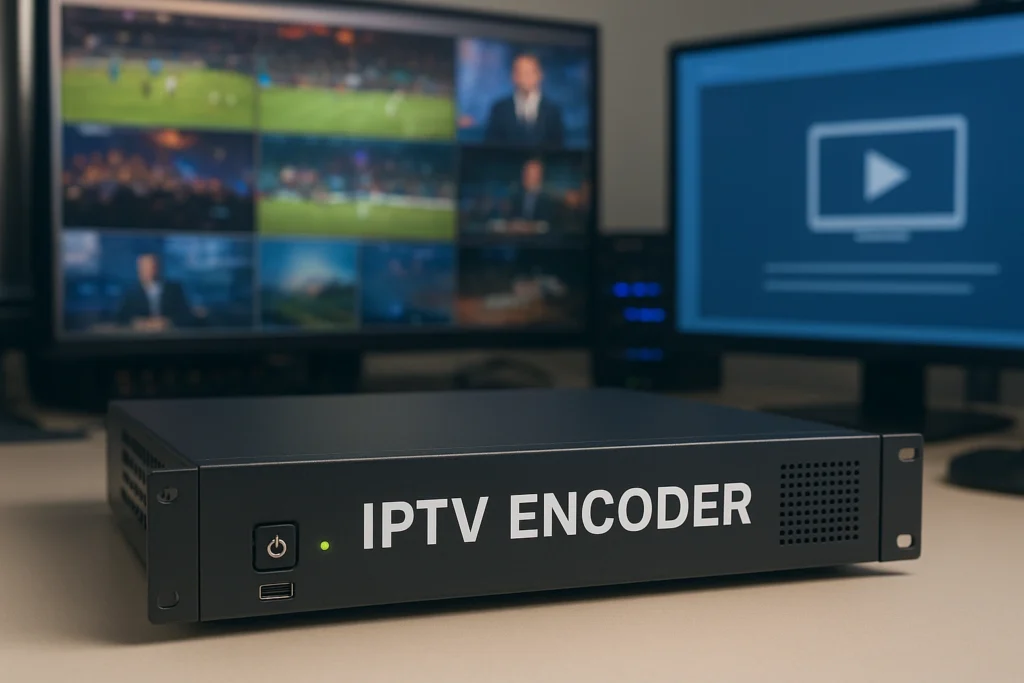
📖 Understanding IPTV Encoders: The Heart of High-Quality Digital Streaming in 2025
Introduction
The evolution of television has gone far beyond traditional broadcasting. From analog signals to digital transmission, and now to internet-based streaming, technology continues to transform how content reaches viewers around the world. At the center of this digital revolution lies a crucial component: the encoder.
In the world of modern streaming, IPTV encoders are the engines that convert, compress, and prepare video content for smooth and efficient online delivery. Without them, the seamless entertainment we experience daily — from live broadcasts to on-demand shows — would simply not be possible.
In this article, we’ll explore what IPTV encoders are, how they work, their types, and why they’re vital for the streaming industry in 2025 and beyond.
What Is an IPTV Encoder?
An IPTV encoder is a device or software that converts video signals into digital formats suitable for transmission over the internet.
Think of it as a translator between the camera and the viewer. When a video feed is captured, it’s often in a raw, uncompressed format — huge in size and impossible to stream efficiently online. The encoder takes this video feed, compresses it, and transforms it into a format that can be streamed in real time without losing quality.
In short, IPTV encoders make it possible to deliver live or recorded content smoothly to users through internet-based streaming platforms.
How IPTV Encoders Work
Here’s a simplified breakdown of how an IPTV encoder functions:
Video Input:
The encoder receives a signal from a camera, satellite receiver, or another video source.Compression and Encoding:
The signal is processed through an encoding algorithm — usually H.264, H.265 (HEVC), or newer formats — to compress the video without sacrificing too much quality.Format Conversion:
The encoded video is converted into a suitable format for streaming (for example, MPEG-TS, RTMP, or HLS).Transmission:
The compressed and encoded video is sent to a streaming server or CDN (Content Delivery Network), ready for distribution to viewers.
This process ensures that large, high-definition videos can be transmitted over the internet quickly, efficiently, and with minimal buffering.
Why IPTV Encoders Are Essential
IPTV encoders are the foundation of every successful streaming system. Here’s why they matter so much:
1. Efficient Bandwidth Use
High-quality video files are massive. Without encoding, they would consume enormous bandwidth. Encoders make files smaller and more efficient, ensuring smooth playback even on moderate internet connections.
2. Improved Video Quality
Encoders use advanced compression techniques that maintain picture clarity while reducing size. With today’s technology, viewers can enjoy HD and 4K quality streams with minimal data use.
3. Low Latency for Live Streaming
For live events, sports, and news broadcasts, latency (delay) is a major concern. IPTV encoders are designed to minimize this delay, keeping streams nearly real-time.
4. Multi-Device Compatibility
An encoded video can be watched on any device — TV, laptop, tablet, or smartphone — without compatibility issues.
5. Scalability for Businesses
Whether it’s a small content creator or a global streaming platform, encoders allow businesses to scale easily, delivering consistent quality to thousands or even millions of viewers simultaneously.
Types of IPTV Encoders
There are two main categories of IPTV encoders: hardware encoders and software encoders.
1. Hardware Encoders
These are physical devices specifically designed to process video signals. They often feature dedicated chips optimized for encoding, which makes them fast and reliable.
Advantages:
Higher performance and lower latency
More stable for 24/7 broadcasting
Better for professional and commercial setups
Disadvantages:
More expensive
Less flexible for quick software updates
Hardware encoders are commonly used by broadcasters, event organizers, and professional streaming services that need consistent, high-quality output.
2. Software Encoders
These rely on a computer’s processing power to handle encoding. They’re ideal for smaller setups or individual streamers.
Advantages:
Affordable and easy to install
Flexible and customizable
Compatible with most operating systems
Disadvantages:
Higher CPU usage
Not ideal for constant or large-scale streaming
Popular examples include OBS Studio and other professional-grade software encoders designed for streaming and video production.
Key Features to Look for in an IPTV Encoder
When choosing an encoder, whether for personal use or a professional streaming setup, there are a few essential features to consider:
Supported Codecs: Look for support for modern codecs like H.264 and H.265, which balance quality and efficiency.
Bitrate Control: Adjustable bitrate helps manage network conditions and maintain stable quality.
Latency Performance: Low-latency options are essential for live broadcasts.
Resolution Support: Choose an encoder that supports HD, 4K, or even 8K, depending on your setup.
Audio Encoding: High-quality audio compression ensures clear sound alongside video.
Streaming Protocols: Compatibility with formats like HLS, RTMP, or MPEG-TS ensures smooth integration with streaming servers.
The Role of IPTV Encoders in 2025
As streaming becomes the dominant form of content delivery, IPTV encoders have evolved significantly. In 2025, they’re not just tools for conversion — they’re smart systems that adapt in real time to deliver optimal quality.
Here are a few trends shaping the future of IPTV encoders:
1. AI-Based Encoding
Artificial intelligence now plays a role in optimizing video quality automatically. AI-powered encoders can analyze network conditions and adjust compression levels on the fly for better performance.
2. Cloud Encoding Solutions
Instead of relying on local devices, many businesses now use cloud-based encoders. This allows for flexibility, scalability, and remote management without physical hardware.
3. 8K and Beyond
With more devices supporting ultra-high resolutions, encoders capable of handling 8K streaming are becoming increasingly common.
4. Sustainability and Energy Efficiency
Modern encoders are being designed to use less power while maintaining high performance — a crucial factor for large-scale streaming providers looking to reduce operational costs.
Common Challenges and How Encoders Solve Them
1. Network Instability
Encoders use adaptive bitrate streaming to automatically adjust quality based on connection speed, reducing buffering and interruptions.
2. Storage Issues
Compressed video files take up far less space, making it easier to manage large libraries of content.
3. Global Accessibility
Encoders help ensure that content can reach viewers in any part of the world with optimized quality for different internet speeds.
4. Consistency Across Devices
No matter what device or platform the viewer uses, the encoded video remains compatible and consistent in quality.
Setting Up an IPTV Encoder (General Overview)
Setting up an encoder is simpler than it might sound. Here’s a general outline of the process:
Connect the Video Source: Plug in your camera, computer, or media device.
Configure Input Settings: Choose the right resolution, frame rate, and audio options.
Select Output Format: Choose your desired codec (e.g., H.265) and streaming protocol.
Add Destination: Enter the server or CDN information where the stream will be sent.
Start Encoding: Begin processing your video and sending it out for streaming.
With modern encoders, most of this setup can be done through simple web interfaces or software dashboards.
The Future of IPTV Encoders
In the coming years, IPTV encoders will continue to evolve with smarter features, improved energy efficiency, and enhanced real-time performance. Integration with cloud systems, edge computing, and AI algorithms will make encoding faster and more adaptive than ever.
For businesses, this means lower costs, more control, and better scalability. For viewers, it means one thing — flawless, crystal-clear streaming every time.
Conclusion
IPTV encoders may not be the most visible part of a streaming setup, but they’re undoubtedly the most essential. They bridge the gap between raw video content and the smooth, high-quality viewing experience users expect.
As the digital entertainment landscape continues to expand in 2025, encoders stand at the heart of innovation — ensuring that every pixel and every sound reaches viewers with precision and clarity.
Whether for live events, educational platforms, or global entertainment networks, IPTV encoders are — and will remain — the silent heroes powering the future of digital streaming.